 Day Trips from Sapporo
Biei and Furano by Car: A Local's Route Around the Summer Crowds
 By Chaporo, a Sapporo local Published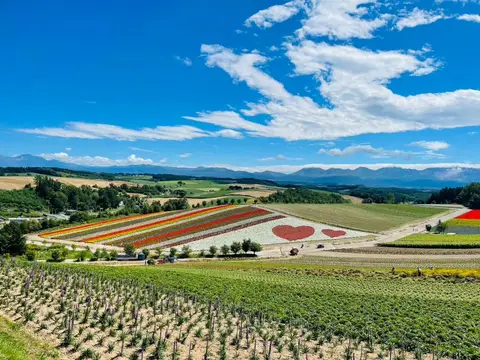
Quick answers
- If you can, start from Asahikawa, Biei or Furano; from Sapporo it is a long day trip, about 2.5 hours each way
- Avoid Route 237 in summer: loop through the mountain side and the hills, and be at Farm Tomita and Shikisai no Oka outside the midday peak
- Farm Tomita is free; Blue Pond parking is 1,000 yen; Shikisai no Oka charges admission from July to September
- Lavender peaks in early to mid July
Biei and Furano are the Hokkaido of postcards: rolling hills in patchwork colors, fields of lavender, and the milky Blue Pond. They are also the busiest part of Hokkaido in summer, and the main road between them turns into a line of rental cars and tour buses. I live in Sapporo and drove the area in mid-August, the most crowded week of the year, on a loop that keeps off that road. This guide is that loop, starting either from Asahikawa, as I did, or as a long day trip from Sapporo, with the drive times, what costs money and when to go.
Where to start: Asahikawa or Sapporo?
If you can, spend the night before in Asahikawa, Biei or Furano and start from there. That is how I drove it: entering from the north in the morning, when the hills were still quiet and almost empty, and working south through the day.
A day trip from Sapporo is possible, but it is a long day. Furano is about two and a half hours from Sapporo by car, and the sights are spread across a wide area of farmland and mountains, so you spend much of the day driving between them. Both versions of the route are below; they are the same loop, driven in opposite directions.
Train, bus or car?
In summer, the seasonal Furano Lavender Express runs directly from Sapporo to Furano, and the JR Furano Line connects Furano, Biei and Asahikawa. That gets you to the towns, but most of the sights are scattered along farm roads and mountain roads with few buses, so seeing more than two or three of them in a day really needs a car. The other option is a day tour, which usually covers Farm Tomita, the Blue Pond and a viewpoint or two.
With a car you can also do the one thing that makes summer here enjoyable: avoid the crowded main road.
Getting there by car
From Sapporo, take the Do-o Expressway toward Asahikawa and exit at Mikasa IC. The toll from Sapporo IC to Mikasa IC is about 1,300 yen for a standard car. From Mikasa it is roughly 1 hour 20 minutes on a mountain road to Furano, about 2 hours 10 minutes to 2 hours 30 minutes in total. Coming from or going back to the Biei side, use Asahikawa-Takasu IC on the same expressway, which you can reach from the hills of Biei without going through the busy town centers.
Why you should avoid Route 237 in summer
Route 237, the main road between Biei and Furano, links most of the famous sights in a straight line, so in the summer season it fills with rental cars and tour buses. Waiting 30 minutes to get into a car park, or being unable to turn right into one and having to loop around, adds up quickly, and by the afternoon you find you have run out of time for the places you planned.
The way around it is to loop through the mountain side to the east and the hills to the west instead of driving up and down the middle of the valley. The Tokachidake Skyline on the mountain side and the farm roads in the hills have almost no traffic lights, so drive times are predictable. Up in the mountains it is also cooler: the Furano basin gets close to 30 degrees in summer, while the Tokachidake viewpoint at 930 meters is breezy and much fresher.
Two ways to drive the loop
The principle is the same either way: be at the most popular places outside the midday peak, and spend the middle of the day on the quieter mountain side.
From Asahikawa (the way I drove it)
Staying near Asahikawa lets you see the hills of Biei in the quiet morning and finish in Furano, then drive back to Sapporo via Mikasa IC.
| Time of day | Stops |
|---|---|
| Morning | Shinei no Oka, with nobody around |
| Late morning | The Jet Coaster Road and Shikisai no Oka, before the tour buses |
| Midday | An early lunch at Cafe de la Paix, Shirahige Falls and the Blue Pond, then up to the Tokachidake viewpoint |
| Afternoon | Senbo Pass, then Farm Tomita once the peak has passed |
| Evening | To Sapporo via Mikasa IC |
As a day trip from Sapporo
From Sapporo, run the same loop the other way round: deal with the most crowded place, Farm Tomita, first thing in the morning, escape to the mountain side while the crowds peak, and save the hills for the afternoon.
| Time of day | Stops |
|---|---|
| Morning | Farm Tomita, before the crowds |
| Late morning | Senbo Pass, then up to the Tokachidake viewpoint |
| Midday | Shirahige Falls and the Blue Pond, lunch at Cafe de la Paix |
| Afternoon | Shikisai no Oka, the Jet Coaster Road, Shinei no Oka |
| Evening | Back to Sapporo from Asahikawa-Takasu IC |
The stops on the loop
These are the stops in the order I drove them, from north to south. On a day trip from Sapporo, read them from the bottom up.
Shinei no Oka
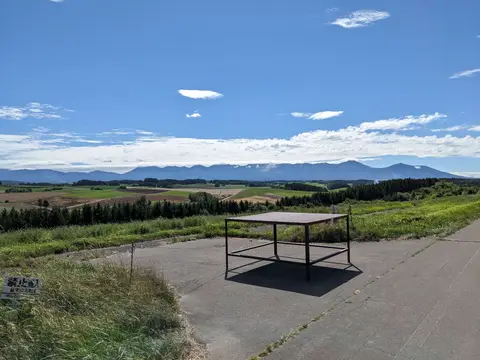
Shinei no Oka is a lookout park with a 360-degree view: the Daisetsuzan and Tokachi ranges to the east and the gentle hills of Biei to the west. It is famous for sunsets, when the hills turn gold, but I recommend the morning too. When I was there early, it was completely quiet, with rolls of hay on the fields and the distant mountains sharp in the clear air, and I had the whole view to myself. It is also the stop closest to Asahikawa-Takasu IC.
The Jet Coaster Road
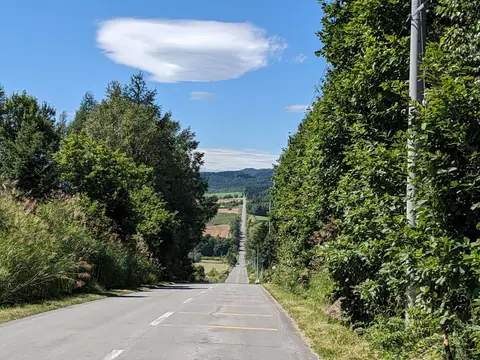
This straight road runs for 2.5 kilometers over a series of steep rises and dips, which is how it got its name. It is one of the eight views of Kamifurano, and from near the top of the climbs you see the farmland of Furano and the Tokachi range in one panorama. Go before the tour buses arrive, drive slowly, and do not stop on the road for photos.
Shikisai no Oka
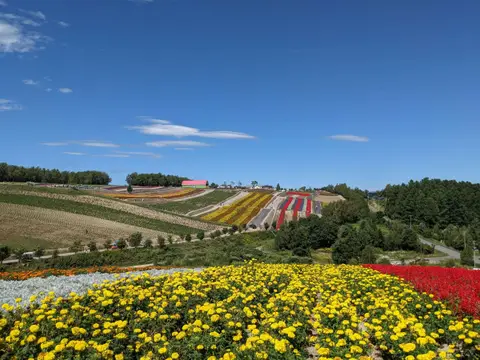
A few minutes from the Jet Coaster Road, Shikisai no Oka is a huge hillside, about three times the size of the Tokyo Dome, planted in stripes with dozens of kinds of flowers, including lavender, sunflowers and cosmos, like a rainbow carpet. Sunflowers can be at their best in August. It gets crowded, but early in the morning it is relatively smooth, and toward evening the low sun makes the colors even richer.
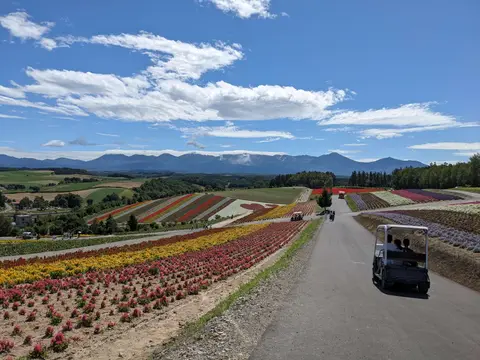
You can ride around on a tractor bus or a cart, and there is an alpaca farm where you can feed the animals. Admission is charged from July to September, 800 yen for adults in 2026.
Lunch at Cafe de la Paix
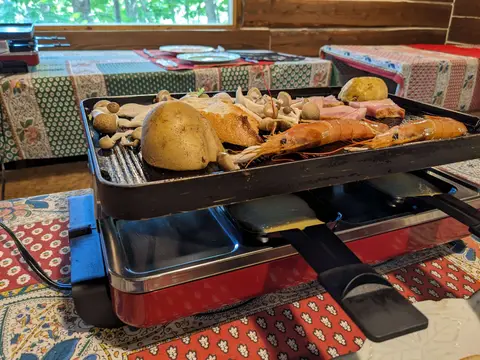
Between Biei town and Shirahige Falls, Cafe de la Paix sits in the forest right on the route, so stopping costs no extra driving. It feels like a hideaway in the woods. The dish to order is raclette: cheese melted on a special plate and poured over sausages, seasonal vegetables and bread. The juicy, gently seasoned sausages and the rich cheese go perfectly together, and the quiet forest makes for an unhurried lunch. Go a little early to avoid the lunchtime queue.
Shirahige Falls and the Blue Pond
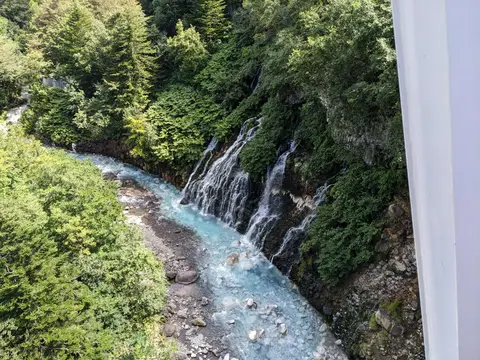
In the Shirogane Onsen area, look down on Shirahige Falls from the bridge, then drive a couple of minutes to the Blue Pond. The falls drop about 30 meters, and the water streams out between the rocks like a white beard into a river colored cobalt blue below. The car parks here get busy; coming from or going to the mountain side, you avoid the line of traffic between here and Biei town.
Parking at the Blue Pond costs 1,000 yen for a standard car. From October 22, 2026 to April 21, 2027, the pond is lit up every evening until 21:00, starting between 16:30 and 18:30 depending on the month; in winter it is covered in snow, so you will not see the blue water then.
Tokachidake viewpoint (Bogakudai)
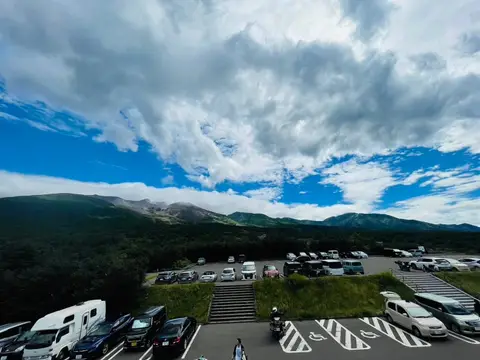
Above Shirogane, the road climbs to the Tokachidake Bogakudai viewpoint at 930 meters. When you get out of the car you can smell sulfur and realize this is an active volcano: in front of you Mt. Tokachi is letting off steam, and behind you the whole Biei and Furano basin spreads out below, with the crowded main road far beneath you. Even in summer the wind is cool, which makes it a perfect break from the drive. There are clean toilets and vending machines inside the volcano shelter.
Senbo Pass
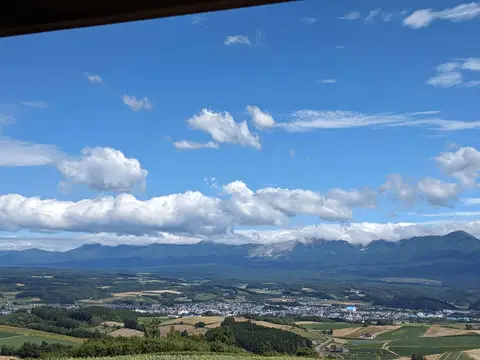
Coming down from Mt. Tokachi toward Kamifurano, go via Senbo Pass instead of dropping onto the main road. It is one of the eight views of Kamifurano and a little-known viewpoint, looking over patchwork fields with the Tokachi range and Mt. Biei-Fuji behind. There are few visitors, so you can enjoy it in peace, and the wide farm road from here, with almost no traffic lights and the mountains straight ahead, is a pleasure to drive.
Farm Tomita
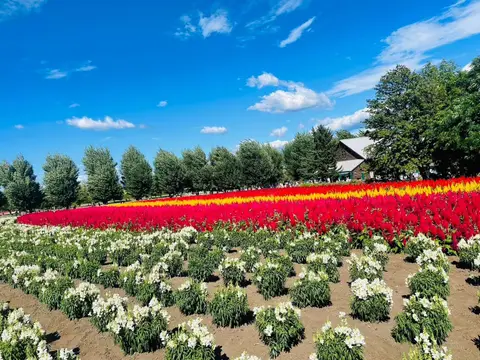
Farm Tomita in Nakafurano is the highlight of Furano and the busiest place on the loop, at its worst around midday. Coming from Asahikawa, you arrive in the late afternoon, when the peak has eased and the low sun lights up the flower beds. From Sapporo, go first thing; in the 10 o'clock hour there are fewer tour groups and a better chance of getting straight into the car park. Admission and parking are both free.
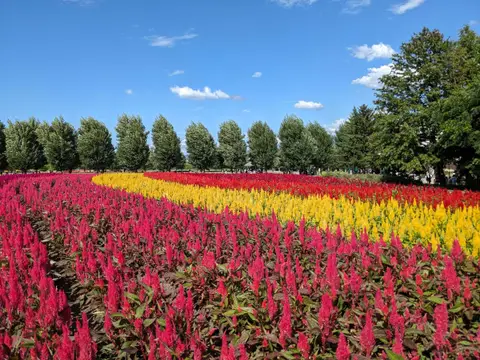
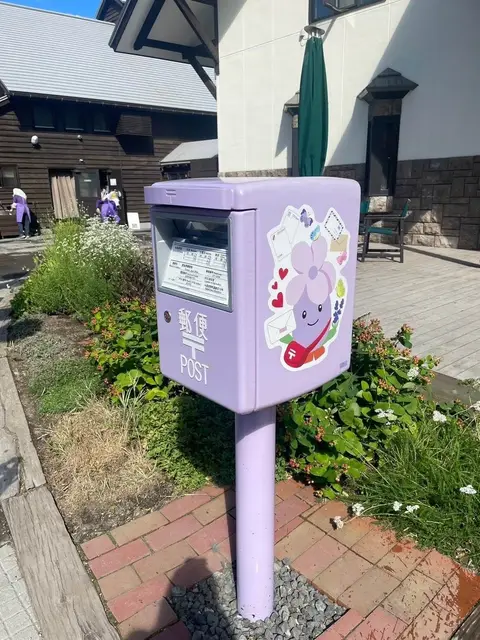
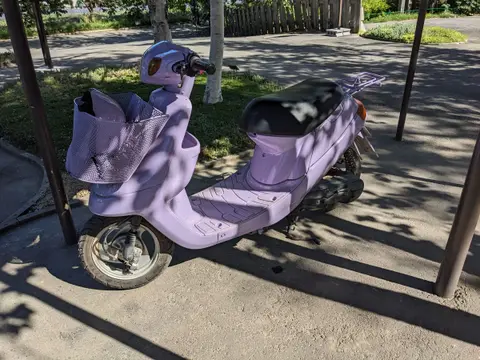
The sight of purple lavender rolling across the fields is something else. The lavender peaks in early to mid July, but into August other flowers such as salvia and marigolds are still in bloom. Try the lavender soft-serve sold on the farm, and look out for the lavender-colored postbox and scooter dotted around for photos.

Tips before you go
A few practical things make the day smoother.
There are no petrol stations or convenience stores along the mountain-side route around the Tokachidake Skyline. Check your fuel in Kamifurano or Biei before heading up, and use the toilets in town; there are some at Senbo Pass and in the Bogakudai shelter, but not many.
Bring a light jacket even in summer. The basin can be close to 30 degrees, but the Bogakudai viewpoint at over 900 meters is windy and feels much colder when you step out of the car.
When is the best time to visit?
For flowers, go in July and August. Farm Tomita's lavender is at its peak in early to mid July, and through August there are other flowers at Farm Tomita and sunflowers at Shikisai no Oka. Those months are also the most crowded, which is why the loop above matters.
In winter the hills are covered in snow and the Blue Pond is lit up in the evenings, but roads are snowy from November to April and days are short. In winter I would stay a night in the area rather than try it as a day trip from Sapporo.
FAQ about Biei and Furano by car
These are the questions people most often ask before going.
Q1. Can you do Biei and Furano as a day trip from Sapporo?
Yes, by car, but it is a long day: about two and a half hours each way, plus driving between sights. Staying a night in Asahikawa, Biei or Furano makes it much more relaxed.
Q2. Should I stay in Asahikawa or Sapporo for Biei and Furano?
If you can, stay near Asahikawa, Biei or Furano. You can see the hills in the quiet morning and spend less of the day driving. From Sapporo it works as a long day trip.
Q3. How do you get from Sapporo to Furano by car?
Take the Do-o Expressway to Mikasa IC (about 1,300 yen for a standard car from Sapporo IC), then about 1 hour 20 minutes on the mountain road to Furano. The whole drive takes about 2 hours 10 minutes to 2 hours 30 minutes.
Q4. How much does it cost to park at the Blue Pond?
1,000 yen for a standard car. Farm Tomita has free parking and free admission.
Q5. When is the lavender season at Farm Tomita?
The lavender is at its best in early to mid July. Early varieties start in late June, and other flowers bloom through August.
Q6. How do you avoid the crowds in Biei and Furano?
Avoid Route 237 in the middle of the valley. Be at Farm Tomita and Shikisai no Oka early in the morning or later in the afternoon, and spend midday on the mountain side at Senbo Pass, the Tokachidake viewpoint and the Blue Pond.
Q7. Can you visit Biei in winter?
Yes. The Blue Pond is lit up in the evenings from late October to late April, though the water is under snow in winter. Expect snowy roads from November to April, and plan to stay overnight rather than drive back to Sapporo the same day.