 Day Trips from Sapporo
Rishiri Island Itinerary: 2 or 3 Days Around Mt. Rishiri by Rental Car
 By Chaporo, a Sapporo local Published
Quick answers
- Fly from Sapporo (Okadama all year, New Chitose in summer); you get about 14:00 on arrival day to 15:00 on departure day on the island
- Rent a car at Rishiri Airport and book it with your flights; a loop of the island is about 56 km and an hour
- Must-sees: Cape Peshi for the harbor and mountain, Himenuma Pond for the reflection, Shiroi Koibito no Oka for the classic peak
- Sea urchin season is June to September; a raw sea urchin bowl was 7,000 yen on June 25, 2026
- Two nights cost me about 200,000 yen from Sapporo, alone
Rishiri Island is a single volcano rising out of the sea off the northern tip of Hokkaido, and you spend the whole trip looking at it. I flew there from Sapporo in late June 2026, rented a car at the airport and drove around the island for two nights and three days: a pond that reflects the mountain, a rocky cape you climb in about half an hour from the ferry terminal, a sea urchin bowl by the ferry terminal and a sea urchin I opened myself on the shore. This guide is that trip with real times, plus a shorter version if you only have one night.
Is Rishiri Island worth visiting?
Yes, if you like mountains and the sea together. Mt. Rishiri (1,721 m), often called Rishiri Fuji for its cone shape, fills the middle of the island, and every road around it gives you a different side of the mountain: reflected in a pond, rising above a harbor, or standing over black lava rocks on the shore. In summer the island also has some of the best sea urchin (uni) in Japan.
It is not a quick trip. Flights are few, so even with two nights I had from 14:00 on the first day to 15:00 on the last day on the island. Here are the numbers from my trip.
| My trip | |
|---|---|
| When | June 24 to 26, 2026 (two nights) |
| Distance driven | About 182 km in three days |
| A loop of the island | About 56 km and an hour without stops |
| Cost | About 200,000 yen for one person from Sapporo (flights, hotel, rental car, food, souvenirs) |
How to get to Rishiri Island from Sapporo
There are two ways: fly, or drive about 310 km to Wakkanai and take the ferry. I flew both ways, because the drive to Wakkanai alone is about six hours each way, so I didn't take the ferry this time.
Flights to Rishiri Airport leave from both of Sapporo's airports: JAL from Okadama Airport, which is inside the city and is a different airport from New Chitose, and ANA from New Chitose Airport in summer only (June 1 to September 30 in 2026, per ANA as of November 10, 2026). I flew to Rishiri on ANA from New Chitose and back to Okadama on JAL, because the New Chitose flight arrives earlier and the Okadama flight leaves later, which gave me the most time on the island.
| Flight | Time | Fare I paid | |
|---|---|---|---|
| Out | ANA, New Chitose to Rishiri | June 24, 12:30 to 13:25 | 41,180 yen (flexible fare) |
| Back | JAL, Rishiri to Okadama | June 26, 16:25 to 17:15 | 21,230 yen (discount fare) |
I booked both on April 19, about two months ahead; the outbound was a flexible fare and the return a discount fare. Fares change a lot by date and fare type. The lowest recent examples on the airlines' own sites were ANA at 21,300 yen round trip between New Chitose and Rishiri (June 21 to 24, 2027) and JAL at 11,000 yen one way from Rishiri to Okadama (November 30, 2026) (ANA, JAL, as of November 13, 2026).
If you need to fly back to New Chitose, for example to connect to an international flight, the July to September 2026 timetable has an ANA flight leaving Rishiri at 14:05 and arriving at 14:55, 2 hours 20 minutes earlier than the 16:25 JAL flight I took (ANA timetable, July to September 2026, as of November 13, 2026).
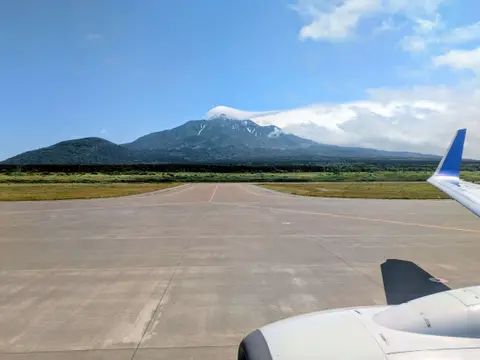
The flight is part of the trip. Out of New Chitose you see the winding Ishikari River, then the Sarobetsu wetland on the coast near Wakkanai, and when the plane stopped on the runway at Rishiri, the mountain was right outside the window.
Do you need a car on Rishiri Island?
To see the island the way I did, yes. The places are spread around the coast and up the mountain, and I drove about 182 km in three days. There are local buses, and in summer a sightseeing bus runs (2026: May 3 to 5 and May 20 to September 30. Soya Bus, as of November 10, 2026), but a car lets you stop wherever the mountain looks best.
I rented a Toyota Yaris from Toyota Rent a Car for about 49 hours, from about 13:30 on June 24 to 15:00 on June 26, for 45,100 yen. I booked by phone on April 19, about two months ahead, the same day I booked the flights and hotel. Cars on the island are limited, so book them with your flights. Besides Toyota, there are other rental companies in Oshidomari and Kutsugata (North Hokkaido tourism site). To drive in Japan you need an International Driving Permit or, for some countries, an official Japanese translation of your license, and traffic drives on the left.
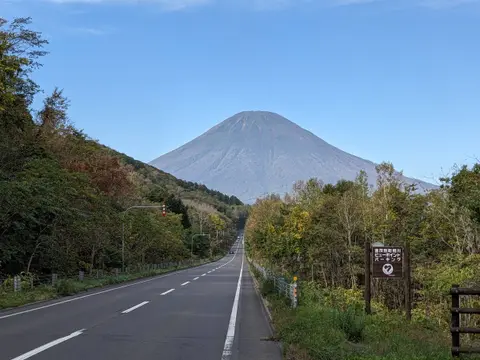 Driving in Hokkaido: A Local's Guide to Renting a Car and the RoadsHow to rent a car and drive in Hokkaido, from a Sapporo local who drives every week: the license you need, expressway tolls and the Hokkaido Expressway Pass, road rules, and winter driving.
Pickup and return were both at Rishiri Airport. I got the key at the counter inside the airport and the car was in the parking lot outside. The unusual part is payment: Toyota's office is at the Oshidomari ferry terminal, and you pay there during opening hours any time before you return the car. I paid on day two when I was at the ferry terminal for lunch. You return the car with a full tank; I filled up once, at ENEOS Oshidomari, just before returning it. To return it, you park at the airport and leave the key in the case inside the car.
The road around the island is one lane each way, fairly wide and quiet. I found it an easy drive even for someone not used to driving.
Where to stay on Rishiri Island
Rishiri has two main towns. Oshidomari, on the north side, is the ferry port, five minutes by car from the airport. Kutsugata, on the west side, is about ten minutes from the airport.
I stayed two nights at Hotel Rishiri in Kutsugata, for two reasons: it has its own hot spring, Rishiri Fureai Onsen, including a lukewarm bath fed straight from the spring source, and restaurants and a Seicomart convenience store are within walking distance, so I could walk to dinner both nights and have a drink. Two nights with breakfast cost 48,500 yen for one person. The best part was breakfast, with a miso soup whose only filling was Rishiri tororo kombu (shaved kelp) that you add yourself, as much as you like.
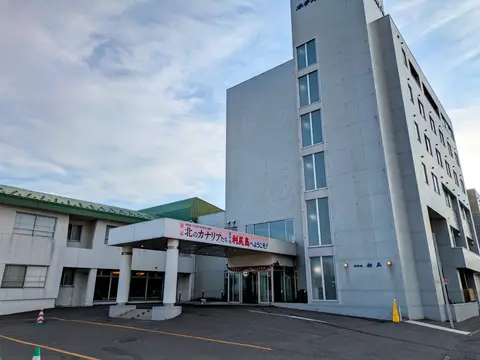
Hotel Rishiri closes for overnight stays in winter: the last night you can stay in 2026 is November 29, and overnight stays reopen in late March 2027, with only the hot spring open in between (Hotel Rishiri, as of November 12, 2026).
My 3-day Rishiri Island itinerary
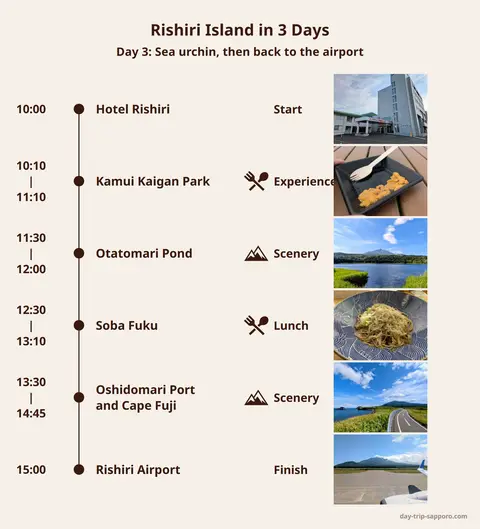
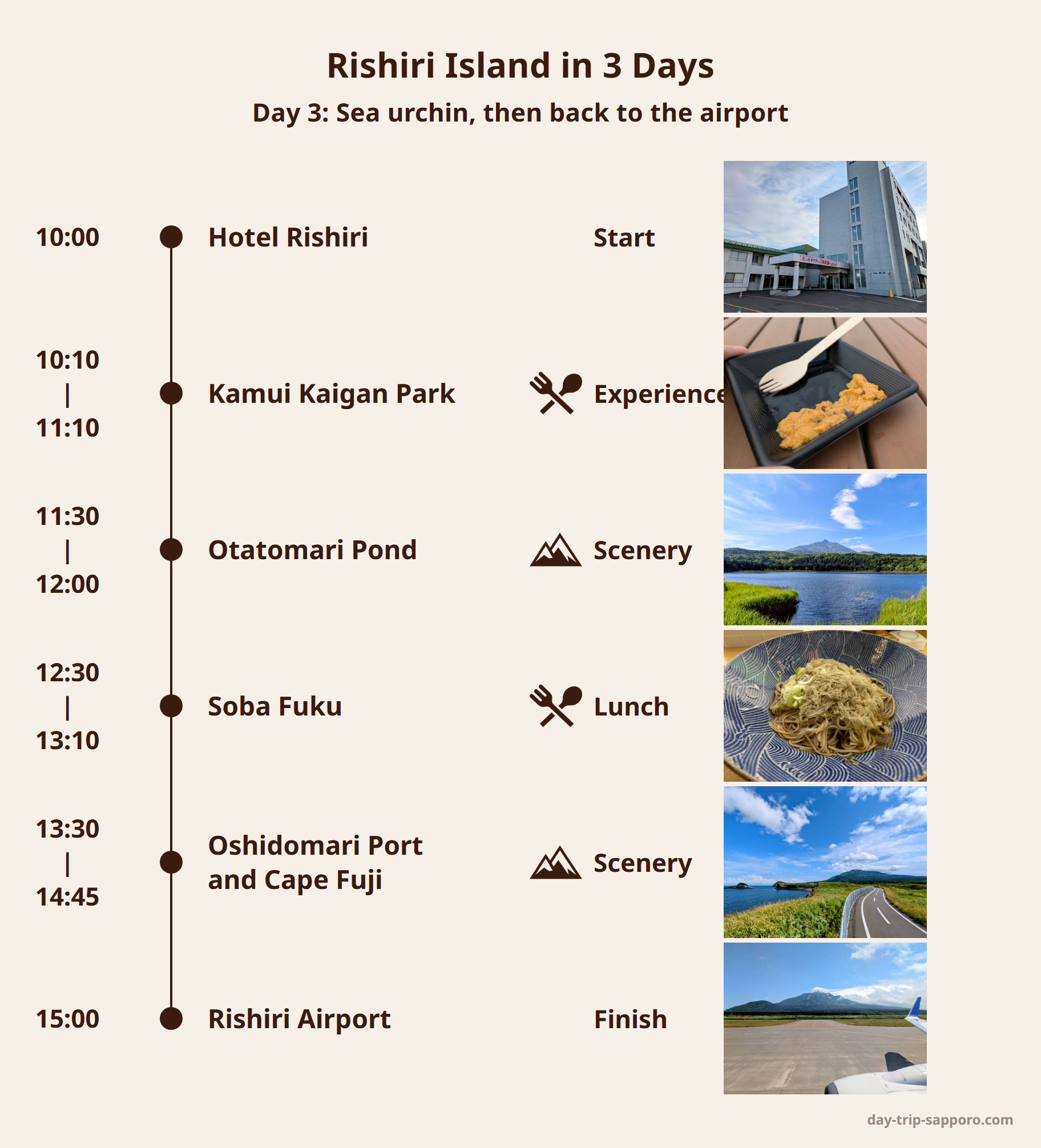
Day one went from the airport around the east and south of the island to the hotel, day two was a full loop, and day three started with sea urchin and ended at the airport.
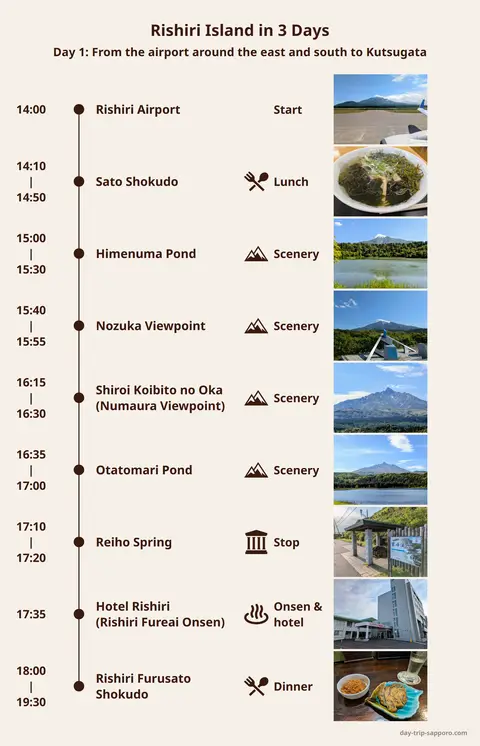
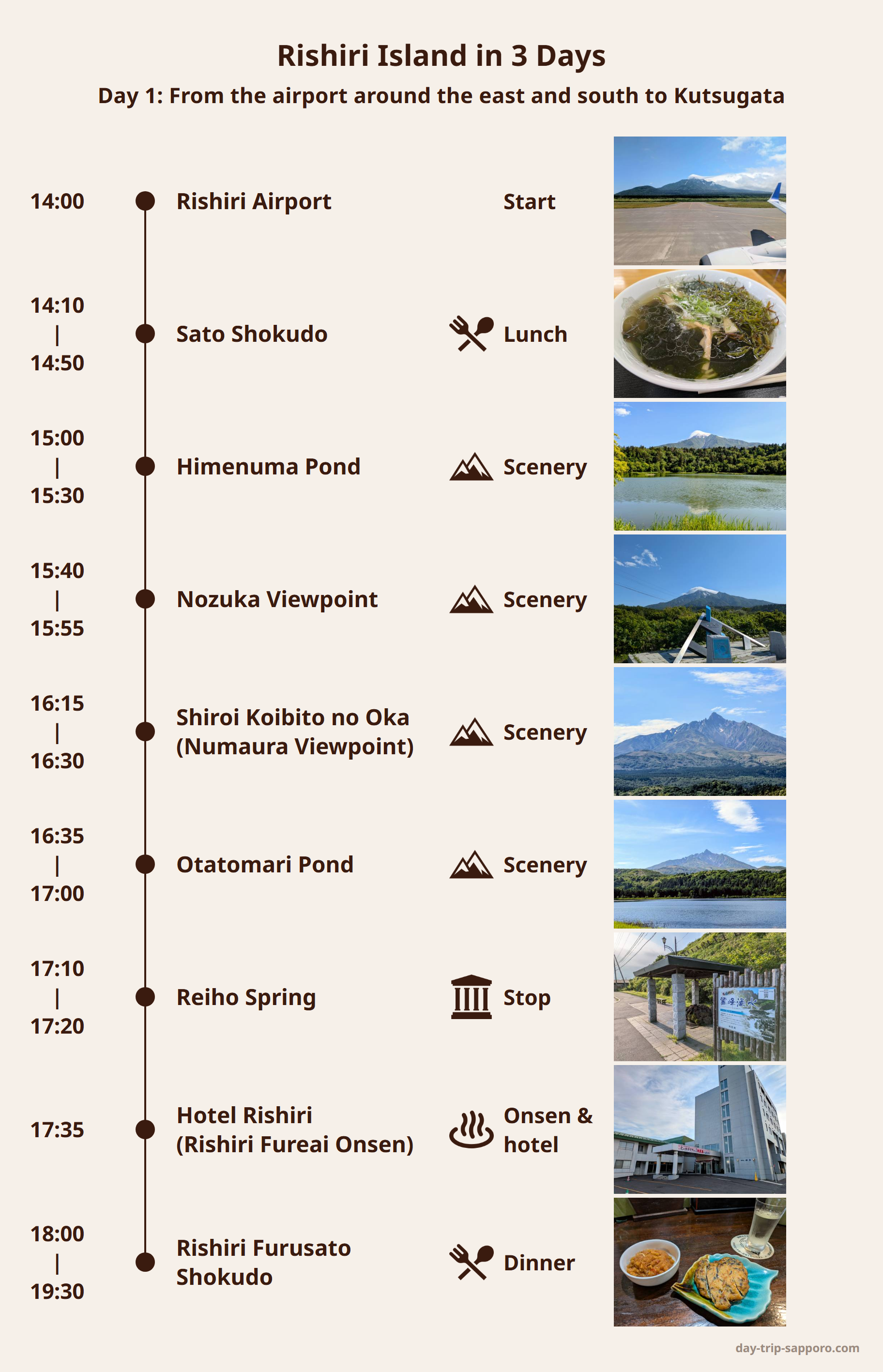
Day 1: Around the east and south coasts to Kutsugata
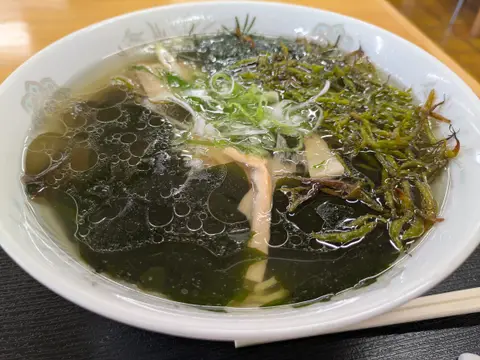
I landed at 13:25, picked up the car and left the airport at 14:00. The first stop was a late lunch at Sato Shokudo, at the back of the row of shops facing the Oshidomari ferry terminal. I had the Rishiri seaweed ramen (1,600 yen), the shop's most popular dish: a light salt ramen in kelp broth, piled with seaweed that ranged from soft to crunchy. You order first at the counter, and they took cash only.
A short drive uphill from Oshidomari, Himenuma Pond sits in the woods. Two or three minutes' walk from the parking lot, the mountain appears across the water, and on my sunny afternoon it was reflected in the pond. A boardwalk goes around the pond in about 20 minutes.
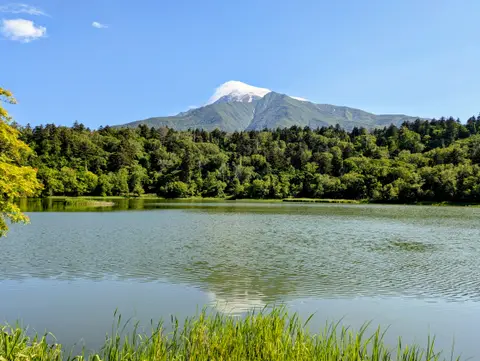
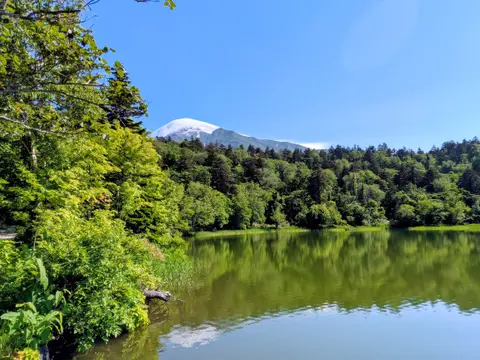 Himenuma Pond on Rishiri Island: Mt. Rishiri Reflected on a 20-Minute Boardwalk LoopHimenuma Pond on Rishiri Island, where Mt. Rishiri is reflected in the water: how long the boardwalk loop takes, how to get there from Oshidomari, parking, and how it compares with Otatomari Pond.
Back down on the coast road, Nozuka Viewpoint is a parking area where you see the mountain and the sea without walking at all.
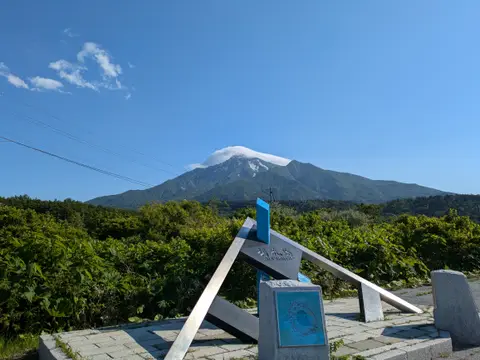
Next came the island's most famous view. The Shiroi Koibito ("White Lover") cookie, a classic Hokkaido souvenir, has Mt. Rishiri on its box, and Shiroi Koibito no Oka, also called Numaura Viewpoint, is where you see the same pointed shape. The parking lot is the viewpoint, so the peak is in front of you the moment you get out of the car.
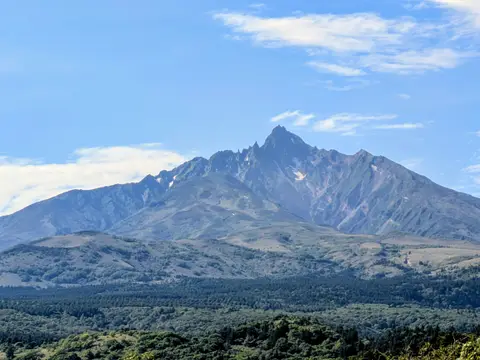
Two or three minutes' drive further is Otatomari Pond, with a big parking lot facing the pond and the mountain. The pond is some distance from the mountain, so the reflection wasn't clean (Himenuma did the reflection better), but the souvenir shop Rishiri Kameichi is right there; I bought Rishiri-kko, a fluffy furikake (rice topping) made with Rishiri kelp.
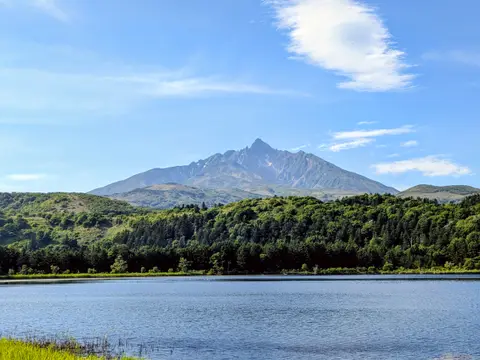 Otatomari Pond on Rishiri Island: The Sharp Peak of Mt. Rishiri and a Souvenir StopOtatomari Pond, Rishiri Island's largest pond, with Mt. Rishiri's sharp summit behind it: how long to stay, parking, the Rishiri Kameichi souvenir shop, and Shiroi Koibito no Oka two minutes away.
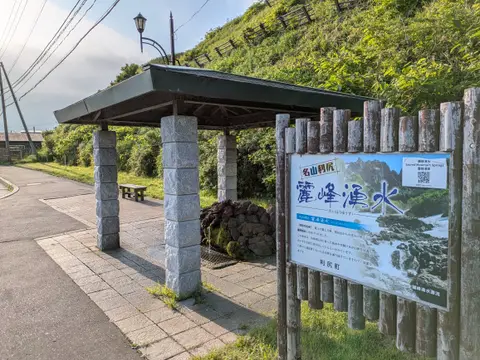
On the way west to Kutsugata, Reiho Spring is a small roofed spot by the road where you fill bottles with spring water. The water was cold and good, and I filled up every time I passed. Bring an empty bottle.
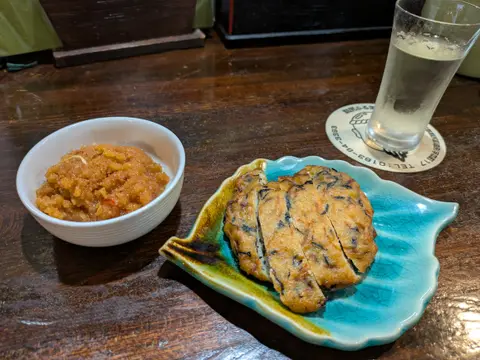
Dinner was a 5 to 10 minute walk from the hotel at Rishiri Furusato Shokudo. On a Wednesday at 18:00, alone, I got a counter seat without a reservation. The dish I remember is gisuko, the roe of a local sculpin, smaller than salmon roe and crunchy like flying fish roe, with a clean saltiness that went well with the local sake, Reiho no Shizuku. Cash only.
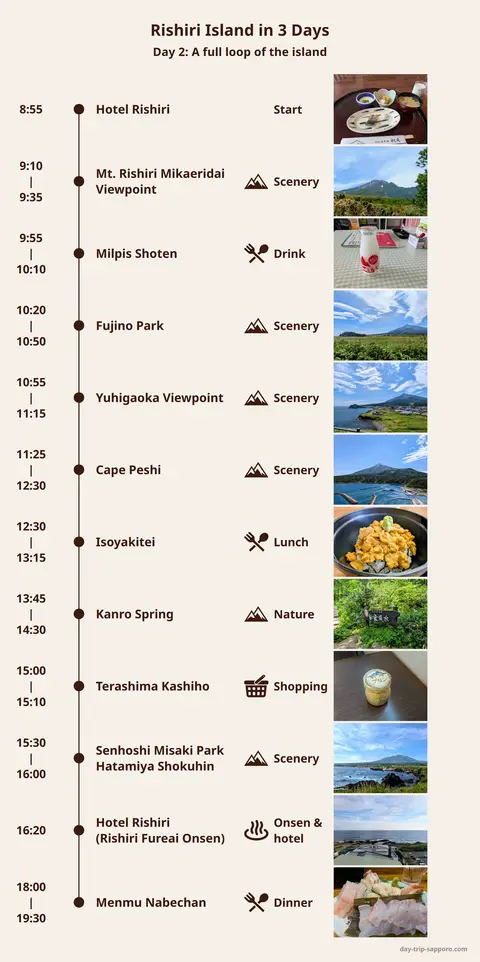
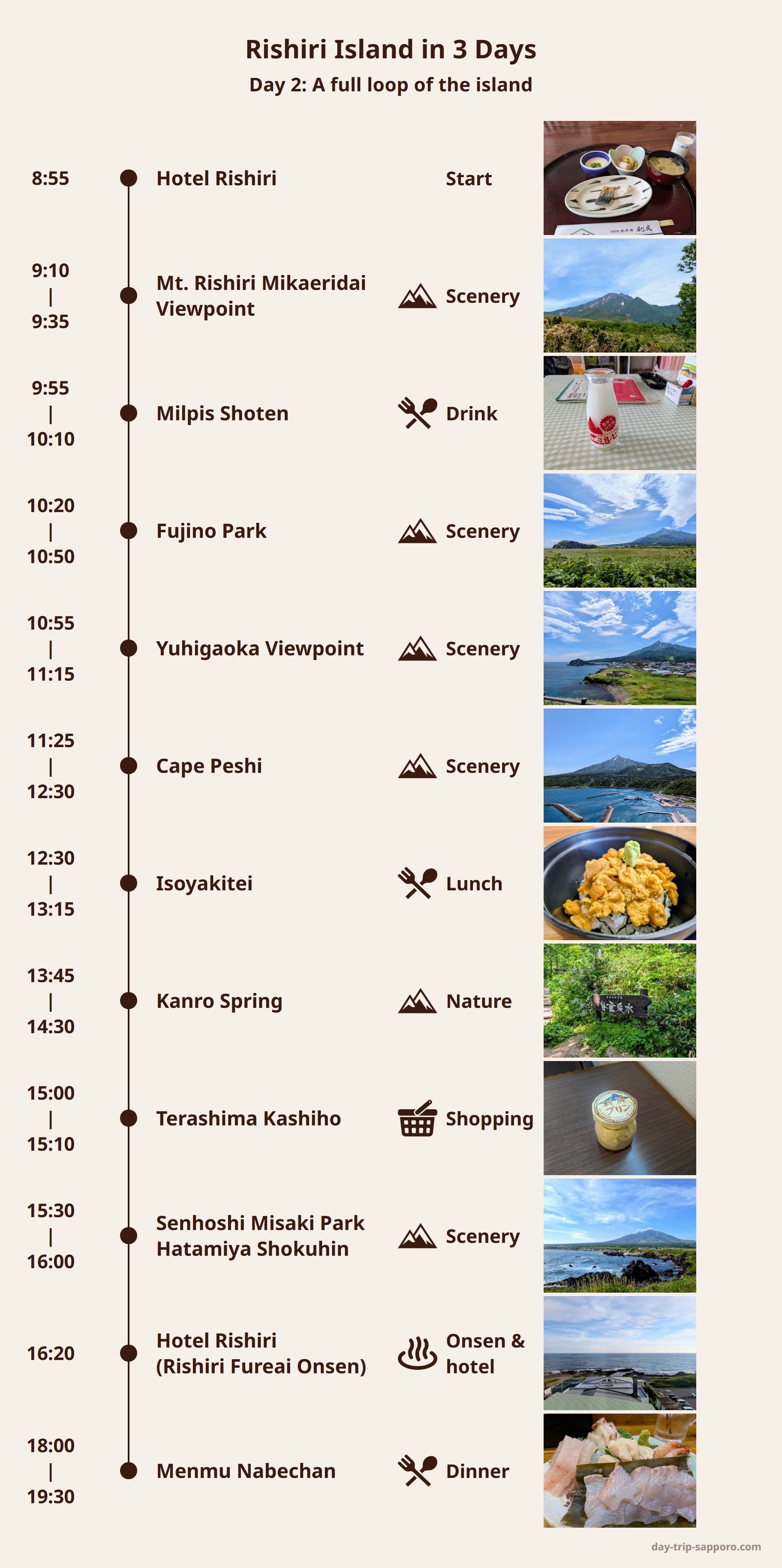
Day 2: A full loop of the island
Day two went clockwise around the whole island, about 78 km including the drives up the mountain to Mikaeridai Viewpoint and Kanro Spring: north to Oshidomari, east to Oniwaki, south to Senhoshi and back to Kutsugata. Cape Peshi, which I climbed that day, was the best place of the trip.
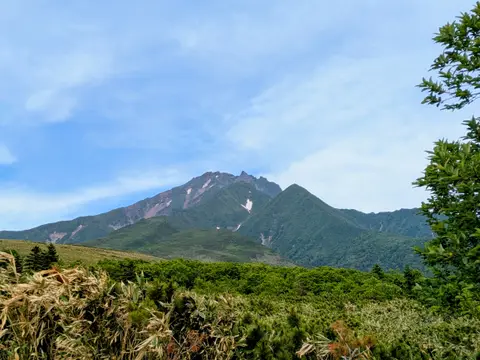
First thing in the morning I drove about 6 km up a mountain road from the hotel to Mt. Rishiri Mikaeridai Viewpoint, halfway up the mountain. You can't see the peak from the parking lot; after a little over ten minutes on paved steps and a path, the mountain appears right in front of you, and behind you the town of Kutsugata and the sea spread out below. My first try was fogged in, and the mountain only showed when I came back later the same day.
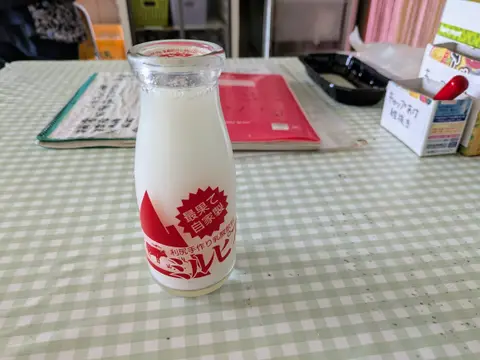
Down on the north coast, Milpis Shoten is an old yellow and blue building selling Milpis, a homemade lactic acid drink, 350 yen a bottle. It tasted like Calpis (sold as Calpico in some countries), a sweet Japanese yogurt-like drink, with a sharper, fresher tang, and you can sit and drink it inside.
Between the airport and Oshidomari, Fujino Park looks at the mountain across a green meadow. Late June to mid-July is the season for the yellow day lilies (ezo-kanzo) there, and on June 25 they were just starting. The hill you can see from the park is Yuhigaoka Viewpoint: five to ten minutes up the stairs, and Oshidomari, Cape Peshi and the mountain fit in one view.
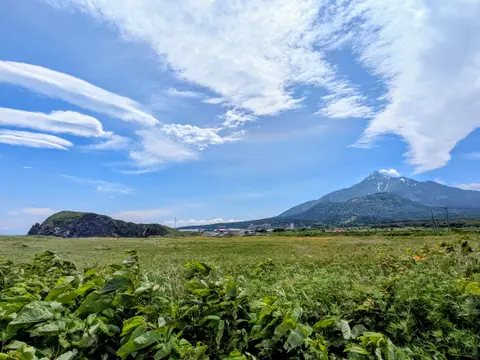
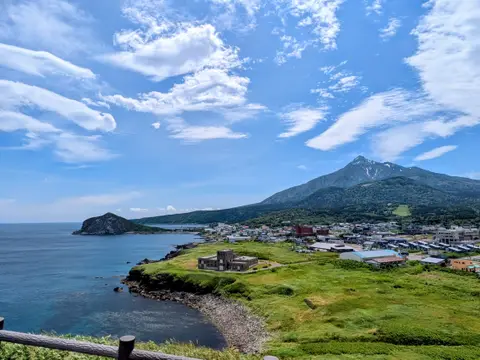
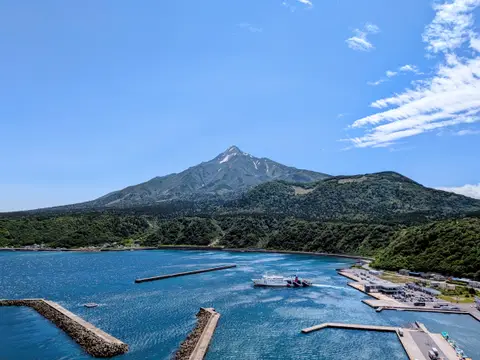
If I could recommend only one place on Rishiri, it would be Cape Peshi. It is a rocky hill sticking out beside Oshidomari's harbor, and from the top you look down on the port and the town with the whole mountain behind them, and open sea on the other side.
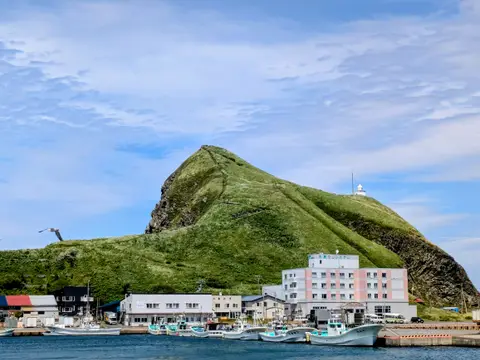
There's no parking at the entrance, so park at the ferry terminal and walk 5 to 10 minutes to the trailhead. From there it took me 23 minutes to the top on the gentle path. The trail splits into a steep path and a gentler one; the steep one is rough rock and was windy, so take the gentle one if in doubt. It has rocky parts too, and I climbed in sneakers.
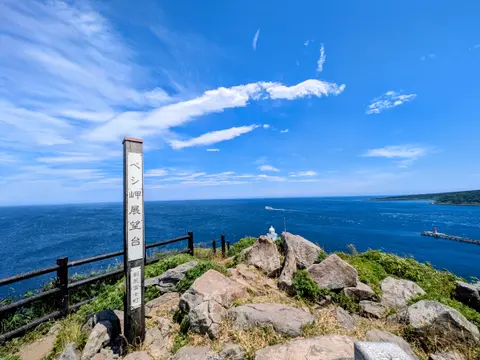 Cape Peshi on Rishiri Island: A 23-Minute Climb to the Best View of the Harbor and Mt. RishiriClimbing Cape Peshi on Rishiri Island: how long it takes, the gentle and steep routes, where to park, and the view of Oshidomari harbor and Mt. Rishiri from the top, from a Sapporo local.
Back down, I left the car at the ferry terminal and walked into Isoyakitei across the street for a raw sea urchin bowl. On June 25 the purple sea urchin (kita-murasaki uni) bowl was 7,000 yen and the bafun (short-spined) sea urchin bowl was 15,000 yen. The uni tasted clean and gently salty, almost like a good broth. Prices change by year and by day.
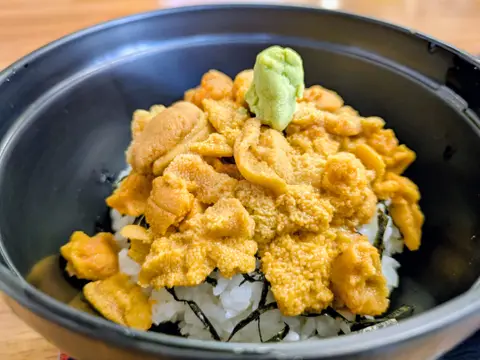
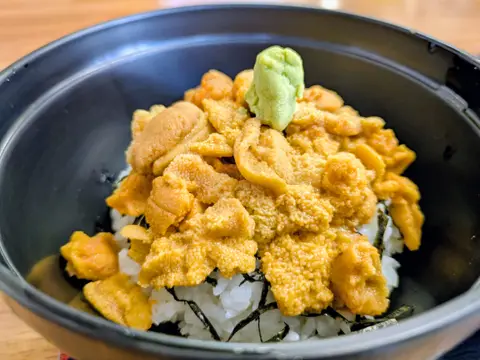 Rishiri Uni (Sea Urchin): When It's in Season, What It Costs and Where to Eat ItWhen sea urchin is in season on Rishiri Island, what a raw sea urchin bowl cost on the day I went, and how it compares with opening a live sea urchin yourself at Kamui Kaigan Park, from a Sapporo local.
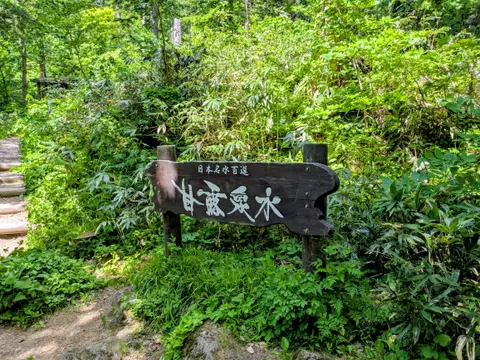
In the afternoon I drove uphill from Oshidomari to the Rishiri Hokuroku campground and walked a little over five minutes along a forest path to Kanro Spring (Kanrosensui), where spring water comes out at the foot of the mountain. Just listening to the water was relaxing.
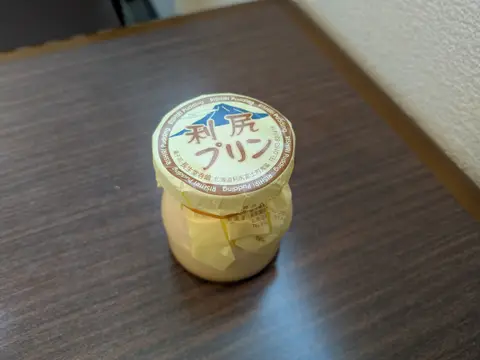
In Oniwaki on the east side I picked up a jar of Rishiri pudding (about 300 yen) at Terashima Kashiho, a small sweet shop with nowhere to eat inside, and had it back at the hotel; it was smooth.
At the southern tip, Senhoshi Misaki Park looks at the mountain across black lava rocks in the sea. It is known for the seals kept in a seawater pool from about June to September, but there were none on June 25, and some days there aren't any (Rishiri Plus, as of November 2026). Hatamiya Shokuhin, next door, sells Rishiri kelp products; I bought tororo kombu. The two together take about 30 minutes.
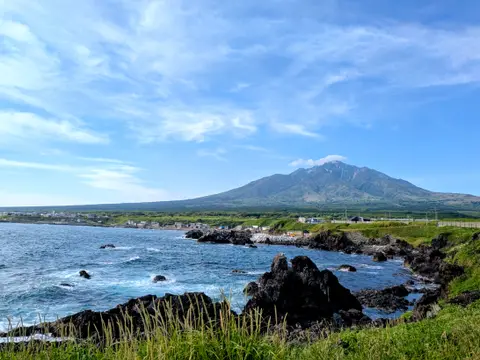
Dinner was a five-minute walk from the hotel at Menmu Nabechan, which opens as an izakaya (a Japanese pub) in the evening. The Rishiri kelp shochu (a Japanese distilled spirit) and Rishiri kelp whisky were 700 yen each, and the sashimi platter, with kelp-cured flounder, started at 2,000 yen. If you want a taste of the island, this is the place.
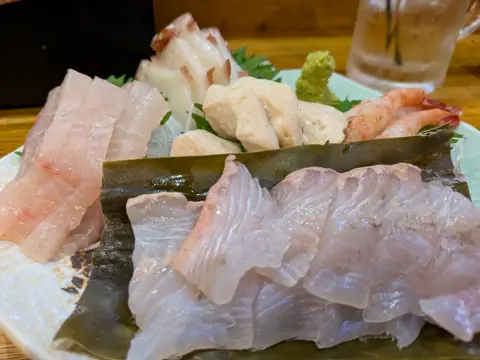
I got into both dinners without a reservation, but another izakaya I tried around 18:00 was fully booked, even in June. Book dinner ahead.
Day 3: Opening a sea urchin, then the airport
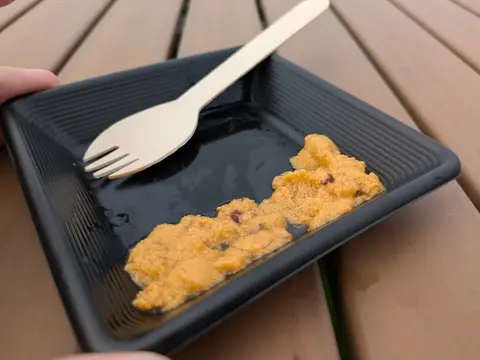
On the last day I left the hotel at 10:00. About 10 minutes by car from Kutsugata, Kamui Kaigan Park lets you open a live sea urchin yourself and eat it on the spot: 2,000 yen for one purple sea urchin, with all the tools provided, so you can come empty-handed. I walked in without a booking and started after about five minutes; the session took about 30 minutes, and I spent another 20 to 30 minutes on the terrace over the black lava shore. It runs June 1 to September 30, 9:30 to 16:30 (Kamui Kaigan Park, as of November 2026).
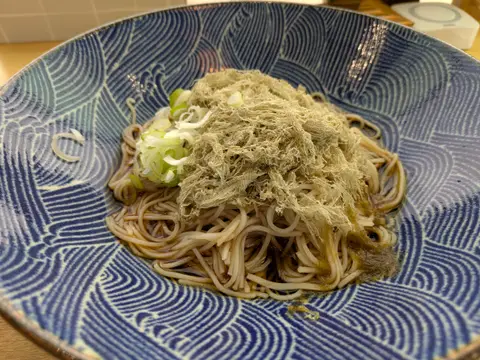
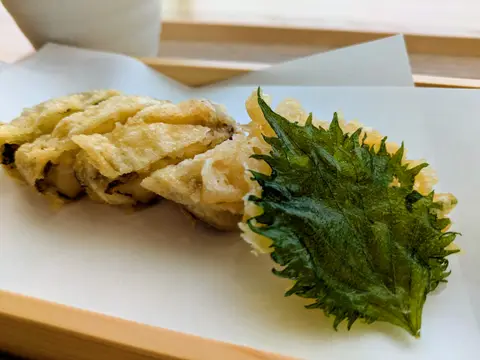
I took one more look at the mountain from Otatomari Pond and had lunch at Soba Fuku, on the second floor of the Oshidomari ferry terminal: cold soba with tororo kombu (1,300 yen), which suits the noodles perfectly, and tempura of Ezo (Hokkaido) abalone (1,600 yen). The seats look out over the harbor.
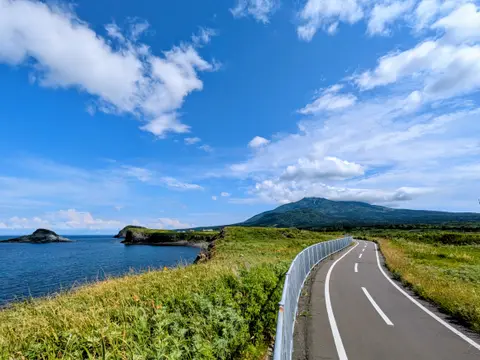
I spent the time before the flight walking around Oshidomari Port, driving the north coast and filling the tank. Near Cape Fuji, between Oshidomari and the airport, the mountain stands at the end of a seaside cycling path. There's no parking there, so if you stop, keep it short and out of the way.
I returned the car at the airport at 15:00. On June 26 the shop and cafe on the second floor of the airport were closed and the first floor has no shop, so buy food and souvenirs before you get there. An hour before departure is plenty.
Rishiri Island in 2 days (one night)
With one night, the flights are the same, and you have from 14:00 on day one to 15:00 on day two.
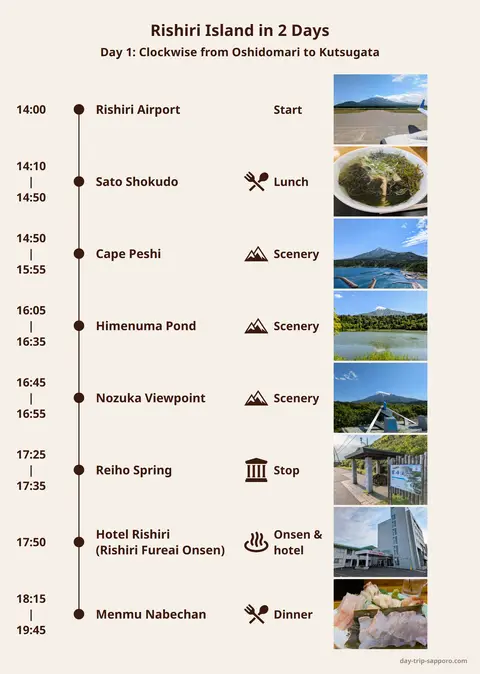
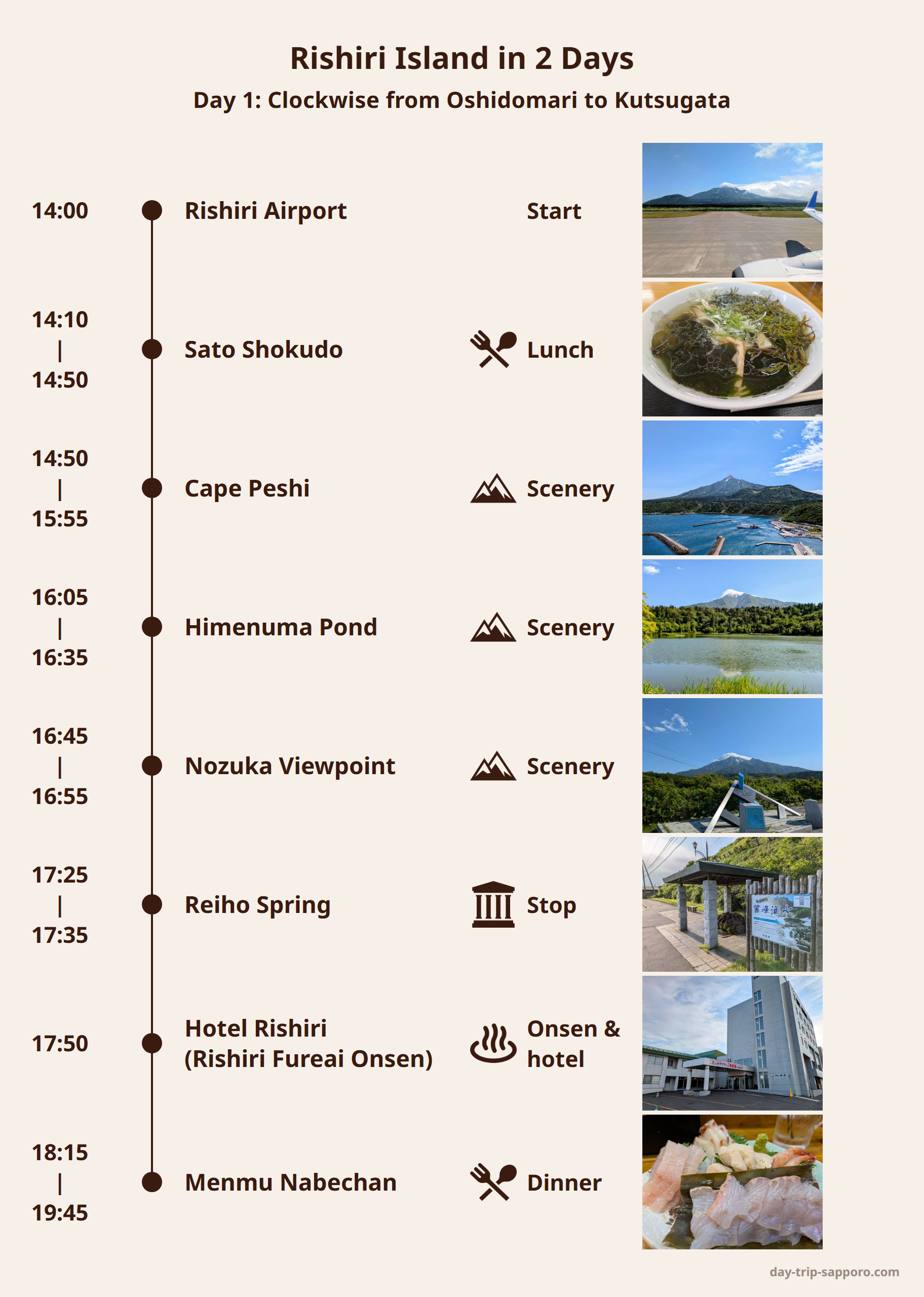
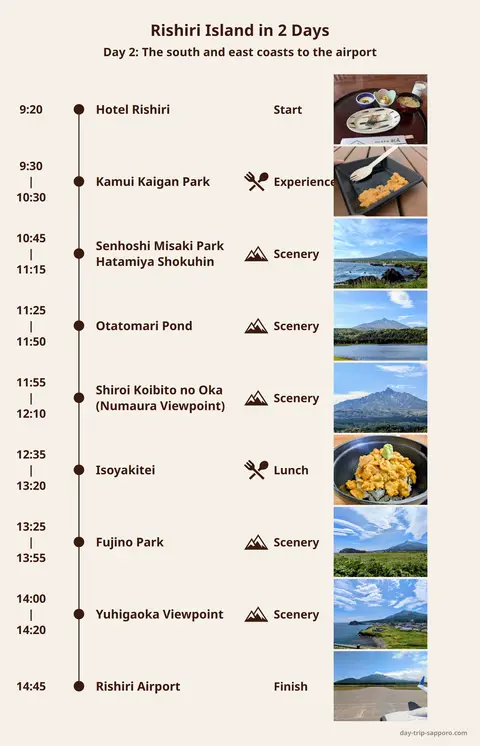
From the three days, I kept the places with the best views of the mountain and two ways to eat sea urchin. The mountain views are Cape Peshi, my one must-see, Himenuma Pond for the reflection, and Shiroi Koibito no Oka for the shape on the cookie box. The sea urchin is the one you open yourself at Kamui Kaigan Park and the raw sea urchin bowl at Isoyakitei. I dropped the places that take a long drive up and a walk, like Mikaeridai Viewpoint and Kanro Spring, and the snack stops like Milpis Shoten and Terashima Kashiho. With only one dinner, I'd choose Menmu Nabechan.
Where to see Mt. Rishiri best
Mt. Rishiri changes shape and setting depending on where you stand. These are the places where I saw it well.
| Place | How the mountain looks | From the car | Good if you want |
|---|---|---|---|
| Himenuma Pond | Reflected in the pond | 2 to 3 minutes' walk | The reflection |
| Nozuka Viewpoint | The whole mountain past the coast road | Right at the parking area | No walking |
| Shiroi Koibito no Oka | The pointed shape on the cookie box | The parking lot is the viewpoint | The classic peak |
| Otatomari Pond | The summit across the pond | In front of the parking lot | Souvenir shopping too |
| Mikaeridai Viewpoint | Looking up at the summit close by | A little over 10 minutes on steps | The mountain up close |
| Yuhigaoka Viewpoint | Town and Cape Peshi with the mountain behind | 5 to 10 minutes on stairs | Town, sea and mountain in one view |
| Cape Peshi | The whole mountain behind the harbor | 30 to 35 minutes (5 to 10 minutes' walk from the ferry terminal, then about 25 minutes up) | The best view, worth the walk |
| Senhoshi Misaki Park | The mountain across lava rocks | Next to the parking lot | Sea and mountain together |
Clouds and fog can hide the mountain. On day three at Kamui Kaigan Park I could only see its lower slopes, and Mikaeridai, halfway up, was fogged in on my first visit even though it was sunny below. Go to the places you care about most while the sky is clear.
When to visit Rishiri Island
June to September is when everything is open: the summer flights from New Chitose, sea urchin, and the hands-on sea urchin experience. I only went in late June, so these are the official seasons (as of November 2026).
| What | Season | Source |
|---|---|---|
| Sea urchin experience at Kamui Kaigan Park | June 1 to September 30 | Kamui Kaigan Park |
| Sea urchin fishing | Purple sea urchin June to September, bafun sea urchin July to August | Rishiri Town |
| Seals at Senhoshi Misaki Park | About June to September (not every day) | Rishiri Plus |
| Day lilies at Fujino Park | Late June to mid-July | Rishiri Plus |
| Himenuma and Otatomari ponds | May to October (closed November to April) | Rishiri Plus |
| Road to Mikaeridai Viewpoint | Mid-May to mid-October (closed by snow in winter) | Rishiri Plus |
| Flights from New Chitose | June 1 to September 30 in 2026 (as of November 10, 2026) | ANA |
In late June it was warm enough for short sleeves in the sun, but capes and the mountain are windy, so bring a layer; on the day I climbed Cape Peshi I wore a thin long-sleeved top all day. There were insects in the forest at Kanro Spring. My first two days were sunny and the third was cloudy.
The island is split into two municipalities, and forecasts list them separately: Rishirifuji Town covers the north and east (Oshidomari, Himenuma, Oniwaki) and Rishiri Town the west and south (Kutsugata, Senhoshi). With the mountain in the middle, the weather can differ.
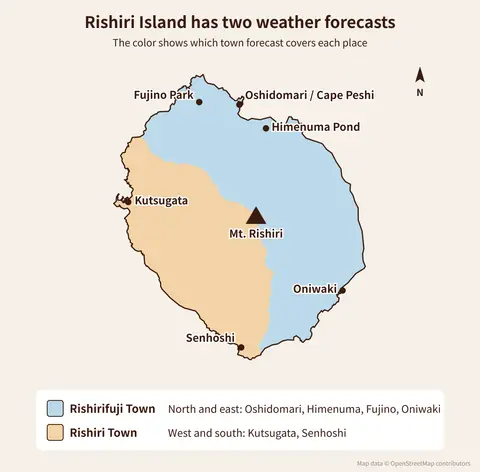
On day two it was cloudy around Kutsugata in the morning, but when I looked back from the north, only the west side was under cloud, and Fujino Park, Yuhigaoka and Cape Peshi on the north side, where I went next, were all under clear skies. If the forecasts differ, start on the sunny side.
How much does a trip to Rishiri Island cost?
My two nights from Sapporo, alone, came to about 200,000 yen. The hotel and car were for one person; two people sharing the car and fuel would come to about 170,000 yen each.
| Cost | Details | |
|---|---|---|
| Flights | 62,410 yen | New Chitose to Rishiri 41,180 yen, Rishiri to Okadama 21,230 yen |
| Hotel | 48,500 yen | Hotel Rishiri, two nights with breakfast |
| Rental car | 45,100 yen | Toyota Rent a Car, about 49 hours |
| Food | About 23,700 yen | Lunches, dinners and convenience store shopping |
| Souvenirs | About 9,800 yen | Rishiri Kameichi, Hatamiya Shokuhin, Terashima Kashiho |
| Sea urchin experience, fuel and so on | About 5,000 yen | Fuel estimated from the distance driven |
FAQ about Rishiri Island
Q1. Can you do Rishiri Island as a day trip?
Not easily. My flight from Sapporo landed at 13:25, and the flights back leave at 14:05 to New Chitose (in the July to September timetable) and 16:25 to Okadama, so a same-day trip leaves only a few hours. Even with one night, you have from about 14:00 to 15:00 the next day. Two nights let you go slowly; one night covers the highlights.
Q2. Can you get around Rishiri Island without a car?
There are local buses and a summer sightseeing bus run by Soya Bus (2026: May 3 to 5 and May 20 to September 30. Soya Bus, as of November 10, 2026). I went by car.
Q3. How long does it take to drive around Rishiri Island?
About 56 km and an hour without stopping. With walks at the ponds and capes, each stop takes 30 minutes to an hour.
Q4. Are there bears on Rishiri Island?
No. A single bear swam over in 2018, and Rishirifuji Town declared on June 28, 2019 that no bears live on the island anymore (Rishirifuji Town, as of November 10, 2026).
Q5. Are there convenience stores and ATMs on Rishiri Island?
There are three Seicomart stores, none open 24 hours: Kutsugata 6:00 to 23:00, Rishiri (Oshidomari) 7:00 to 22:00, and Oniwaki 6:00 to 21:00 (Seicomart store search, as of November 10, 2026). For cash, there is a Japan Post Bank ATM at the Rishiri Kutsugata post office. Sato Shokudo and Rishiri Furusato Shokudo were cash only, so bring enough.
Planning your Rishiri trip
With a car, two nights on Rishiri are enough to circle the island and see the ponds, viewpoints, capes, sea urchin and hot spring. If you'd rather see the island from mainland Hokkaido, the drive up the Ororon Line to Wakkanai has the closest view of it.
 Sapporo to Wakkanai by Car: The Ororon Line Coast Road to Cape SoyaDriving from Sapporo to Wakkanai up the Ororon Line, the Sea of Japan coast road, from a Sapporo local who did it: the stops, the closest view of Rishiri Island, sunset at Cape Noshappu, and Cape Soya and the White Road the next morning.